Otto Carson
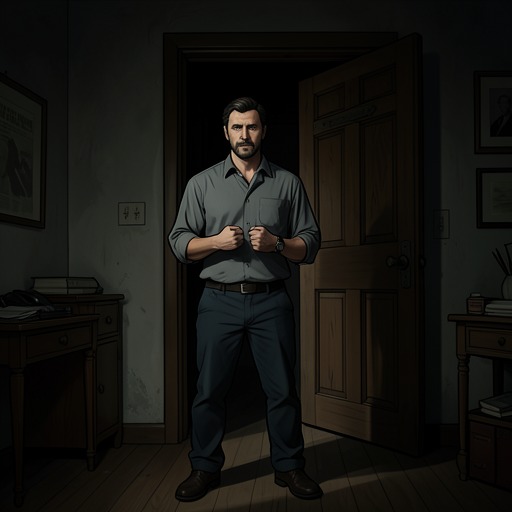
American RustOtto Carson is the man killed in the machine-shop confrontation that entangles Isaac English and Billy Poe in a murder investigation. The evidence presents him in two sharply different ways: Bud Harris describes a man with a history of violence whom he considers dangerous, while Isaac English’s later reckoning insists that Carson was not attacking anyone at the instant he was killed. That tension makes Carson more than the absent subject of an investigation. His death becomes the point at which self-defense, loyalty, and responsibility refuse to settle into a single account.
Identity and Known Record
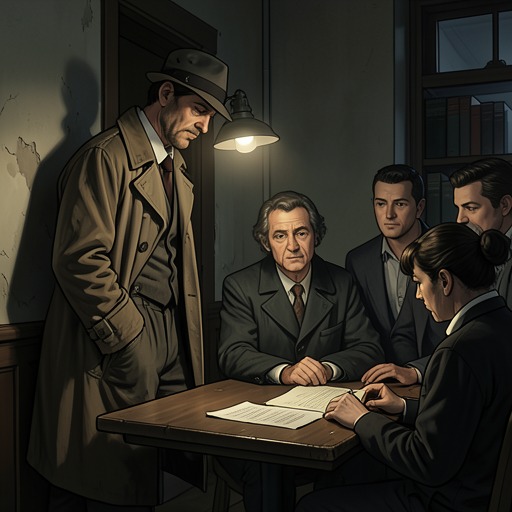
Carson’s name enters the account when Bud Harris takes digital photographs from a manila folder and passes them to Billy Poe. Poe’s immediate reaction to the photographs tells Harris that he recognizes the scene. Harris identifies the deceased man as Otto Carson and explains that the case has drawn attention from a new district attorney in Uniontown, Pennsylvania. A dead woman has been found in a dumpster without clues, and the Pennsylvania State Police want to confiscate Poe’s sneakers. The evidence does not establish the precise connection between the woman, the photographs, and Carson, but Harris presents these details together to make clear that Poe’s flight has left him exposed to an active investigation.
Harris offers a pointed account of Carson’s past. He says Carson had been jailed for various offenses, had spent time in mental wards, and had two outstanding assault warrants, one from Baltimore and one from Philadelphia. Harris also characterizes him as someone who was likely to kill somebody sooner or later, and speculates that he may already have done so. This is Harris’s assessment, not an independently narrated account of Carson’s crimes. The distinction matters: the record supplied here establishes Harris’s view of Carson as dangerous, but gives no scenes from Carson’s life before the fatal encounter and no further confirmation of the acts Harris attributes to him.
The Machine-Shop Death and Its Immediate Aftermath
Carson’s death is bound up with Poe’s presence at the machine shop and the choices made after the killing. Harris tells Poe that, had Poe come to him immediately, the case might have supported an uncomplicated self-defense plea or might even have disappeared without prosecution. Instead, Poe ran. Harris says that another man who was at the machine shop is now claiming that Poe killed his friend. The account therefore gives Carson two roles in the immediate aftermath: he is the deceased person at the center of the investigation, and he is the friend whose death a witness attributes to Poe.
Harris’s response is neither a declaration that Carson’s death was justified nor a promise that the case will be ignored. He stresses that Carson’s history could have mattered to a defense, while also making clear that Poe’s flight has altered the situation. The photographs, Poe’s recognizable reaction, the attention to his shoes, and the witness’s accusation turn what Harris imagines might have been manageable into a perilous legal problem. Carson himself cannot speak in this account; the competing interpretations reach the reader through the people left to explain what happened.
Isaac English’s Recollection and the Problem of Blame
Carson also persists in Isaac English’s thoughts after Isaac has been assaulted by local delinquents and returns to the warehouse area. Isaac imagines a debt owed to the Swede Otto and casts his painful survival in the language of repayment and redemption. The grand, almost sacred terms of this private story do not resolve what happened. Instead, they show Isaac trying to give meaning to violence while still feeling that the debt remains unpaid.
Later, Isaac tests the claim that Carson had simply been standing there and doing nothing. He recognizes that this version is a lie he is telling himself to evade prison. His recollection supplies a crucial circumstance: if Isaac had not killed Carson, Jesús would have cut Isaac’s throat. Isaac frames the encounter as a choice between himself and Carson, and uses the language of a necessary condition to argue that the killing should not be charged to him. Yet he also sees the evasion inside that reasoning. Thinking harder, he realizes, would only give him more ways to justify himself.
Isaac’s final reckoning does not erase the circumstances that made the moment feel unavoidable. It distinguishes that explanation from the truth he believes matters most: he, Isaac, was responsible for Carson’s death. In the same reflection, he considers other truths, including the fact that Billy Poe’s fate is bound to the killing, but refuses to let those truths cancel his own responsibility. Carson’s death thus survives as a moral fact even when the surrounding account offers grounds for self-defense and for loyalty to Poe.
Narrative Significance
Carson is characterized mainly through what others say and remember, not through an independent portrait. Harris’s description makes him legible as a violent repeat offender whose past could have shaped the legal response. Isaac’s recollection complicates that portrait by holding together the immediate danger, Carson’s apparent inaction at the decisive instant, and Isaac’s responsibility for killing him. Neither account simply replaces the other: one explains why Carson might have seemed dangerous, while the other exposes the limits of turning necessity into innocence.
The consequences of Carson’s death extend beyond the machine shop. Poe’s departure from the scene leaves him vulnerable to accusation, and Harris’s account makes clear that timely disclosure might have changed the case. Isaac’s later self-interrogation, meanwhile, turns Carson into the measure of how far an explanation can go before it becomes an excuse. The novel’s limited evidence about Carson is itself significant: the dead man remains partly unknowable, while the living characters’ attempts to interpret his death reveal their competing loyalties and their different ways of confronting guilt.